Automated Manufacturing Solutions for Orthopedic Implants
Validated automation for knee or hip – from coating, handling to packaging
Orthopedic implants leave no room for variation. Every femoral component, acetabular cup or tibial tray must meet tight tolerances, defined surface specifications and complete documentation requirements. IMSTec designs and builds automated production solutions that make these requirements reproducible – at scale and under regulatory control.

Challenges in Orthopedic Implant Manufacturing
Demanding materials and complex geometries
Demanding materials and complex geometries
Orthopedic implants are typically made from titanium alloys, cobalt-chromium-molybdenum alloys or stainless steel. These materials are difficult to machine, and many implants feature freeform surfaces or porous structures. Small deviations in clamping, positioning or tool condition directly affect dimensional accuracy and surface quality.
High product variance
High product variance
A single implant system often includes dozens of sizes and left/right variants. Frequent changeovers, small batch sizes and growing demand for patient-specific implants make manual handling time-consuming and prone to errors.
Manual process steps as a quality risk
Manual process steps as a quality risk
Loading machines, deburring, polishing and visual inspection are still performed manually in many production environments. These steps depend on operator skill, are difficult to standardize and represent a significant source of variation – and of non-conformances.
Regulatory requirements and documentation effort
Regulatory requirements and documentation effort
Manufacturers must comply with ISO 13485, the EU MDR and FDA requirements (21 CFR Part 820). Processes whose output cannot be fully verified must be validated. Every implant must be traceable – from raw material lot to UDI marking. Without consistent data capture, the documentation effort grows with every unit.
Cost pressure and skilled labor shortage
Cost pressure and skilled labor shortage
Rising volumes, price pressure in healthcare systems and a shortage of qualified machine operators require production concepts that increase output without compromising quality.
Automated Multi-Load Station
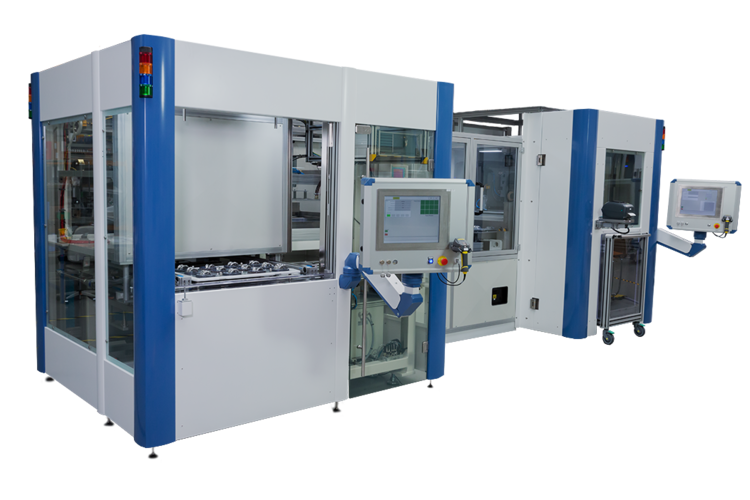
The IMSTec Automated Multi-Load Station (IAML) automatically assembles and loads orthopedic implants into multiple machining systems for downstream processing. The system is designed to handle the full range of implant sizes.


Process expertise:
Single point of responsibility
Regulatory competence
Life cycle support
Subsidiary in the USA
Quality Control and Inline Inspection
In orthopedic implant manufacturing, quality cannot be inspected in at the end of the line – it has to be controlled throughout the process. IMSTec integrates inspection directly into the production flow.
Inline inspection instead of end-of-line sampling
Inline inspection instead of end-of-line sampling
Measuring and inspection stations are integrated at critical process steps. Deviations are detected where they occur – before further value is added to a non-conforming part.
Automated visual inspection
Automated visual inspection
Camera-based vision systems detect surface defects such as scratches, pores, burrs or residues. Defined inspection criteria replace subjective manual visual checks and deliver reproducible, documented results.
Dimensional and surface measurement
Dimensional and surface measurement
Depending on the application, optical, laser-based or tactile measuring methods verify critical dimensions and geometries. Surface roughness measurement verifies specifications for articulating and bone-contacting surfaces.
Complete traceability
Complete traceability
Each part is assigned a unique ID and tracked through every process step. Process parameters, inspection results and operator actions are linked to the serial number – providing the data basis for your Device History Record (DHR) and UDI requirements.
Compliant data handling
Compliant data handling
Data acquisition and system software can be designed to meet data integrity requirements such as 21 CFR Part 11 and GAMP 5, including audit trails, user management and electronic records.

The IMSTec Approach:
Automation Built Around Your Process
From feasibility study to qualified system
Every project starts with a structured analysis of your product and process. We assess automation potential, identify critical process parameters and define the appropriate degree of automation – from semi-automated cells to fully automated production lines.
Risk-based engineering
We apply established methods such as process FMEA (pFMEA) from the concept phase onwards. Process risks are identified early and addressed through design, sensors or inspection steps – before they reach production.
Validation-ready by design
Our systems are developed according to GMP and FDA-relevant requirements. We support you throughout qualification (FAT, SAT, IQ/OQ/PQ) and provide the documentation required for your validation strategy.
Modular and scalable
Modular system concepts allow you to start with individual process steps and increase the degree of automation as volumes grow – without redesigning the entire line.
Integration into existing production
We integrate CNC machining centers, grinding machines, marking systems, measuring equipment and higher-level systems such as MES into a coordinated process chain – including existing equipment from different OEMs.
Manufacturing Processes for Orthopedic Implants
The production of an orthopedic implant typically involves a sequence of tightly linked process steps. IMSTec automates individual steps or connects them into a continuous process chain.
Let's Discuss Your Implant Production
Our engineers will analyze your current process and show you where automation delivers measurable value – technically and economically.